
Compound Interest, Explained (With Real Numbers)
Compound interest is often called the eighth wonder of the world, a line usually pinned on Einstein, though there's no real evidence he ever said it. Apocryphal or not, it captures something true: compounding is quietly one of the most powerful forces in personal finance, and most people don't feel how powerful until they see the actual numbers.
So let's use real numbers. This is a plain-English walkthrough of what compound interest is, why time is the secret ingredient, and how to estimate it in your head.
What compound interest actually is
Simple interest pays you a percentage of your original amount, and that's it. Compound interest pays you interest on your interest, each period, your gains get added to the balance, and the next period's interest is calculated on the new, larger total.
That small difference is everything. In the early years it's barely noticeable, which is why compounding feels underwhelming at first. But because each year builds on the last, the growth curve bends upward more and more steeply over time. The longer it runs, the more dramatic it gets.
A worked example: why $10,000 becomes $76,000
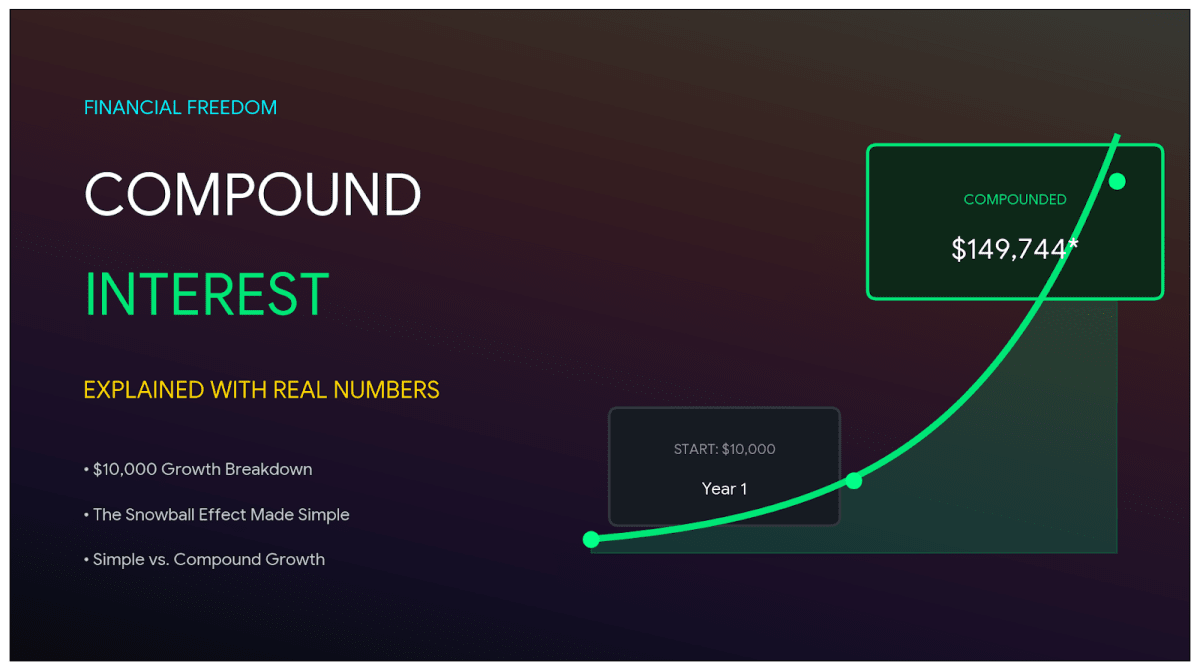
Say you invest $10,000 once and leave it alone at a 7% average annual return (a figure often used for long-run stock-market averages before inflation). After 30 years, it doesn't become $10,000 plus 30 years of interest on $10,000, it grows to roughly $76,000.
That's more than seven times your money, and you never added another cent. The extra came entirely from interest earning its own interest, year after year. Stretch it to 40 years and it climbs past $149,000. The only thing that changed was time.
Small, regular amounts add up more than you'd think
Now flip it to regular saving. Put away $200 a month at that same 7% average return, and over 40 years you'd contribute $96,000 of your own money, but end up with over $500,000. The other $400,000-plus is compounding doing the heavy lifting.
This is the real lesson for anyone saving for retirement: how much you contribute matters, but how long you let it compound often matters more. Starting ten years earlier can beat contributing far more later.
The Rule of 72: mental math for doubling
Here's a genuinely useful shortcut. To estimate how long an investment takes to double, divide 72 by the annual interest rate. At 6%, money doubles in about 12 years (72 ÷ 6). At 8%, about 9 years. At 3%, around 24 years.
The Rule of 72 isn't exact, but it's close enough to be handy, and it makes the cost of a low return obvious: the difference between 4% and 8% isn't 'twice as good', it's the difference between doubling your money every 18 years versus every 9.
Compounding works against you too
The same force that grows your savings grows your debts. Credit card interest compounds, often daily, which is exactly why a balance at a 20%-plus APR can spiral so fast. Compounding doesn't care which direction it's pointing.
The takeaway is symmetrical: let compounding work for you by investing early and consistently, and stop it working against you by clearing high-interest debt quickly. To see either side with your own figures, run them through our free compound interest calculator, and for debt, the credit card payoff calculator.
Tools mentioned
Compound Interest Calculator
See how savings grow with compound interest and optional regular contributions.
SIP Calculator
Project the future value of a Systematic Investment Plan with regular monthly investments.
Retirement Savings Calculator
Estimate how much your retirement nest egg will grow by the time you retire.